
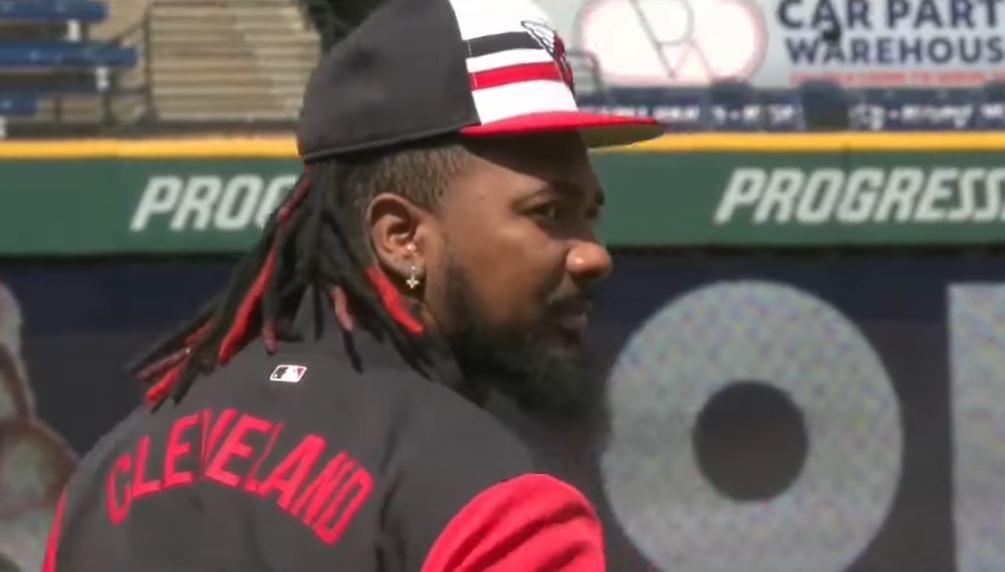
The career of Luis Ortiz is a study in contrasts; a pitcher whose speed once wowed scouts, he is currently in the news for non-baseball-related reasons. His 2025 salary of $782,600 was intended to represent advancement, a step toward both financial stability and professional recognition. Rather, it served as a benchmark for the speed at which a career can change from promising to uncertain.
Ortiz, who was born in San Pedro de Macorís, the same city that gave birth to legends like Robinson Canó and Sammy Sosa, pursued the well-known Dominican dream of signing at a young age, pursuing major-league success, and raising his family from humble beginnings. He was making slightly more than MLB’s minimum salary on a pre-arbitration contract when he joined the Cleveland Guardians. His $782,600 salary felt like a hard-won victory for an athlete who lived in minor league housing for years.
Luis Ortiz – Personal and Professional Information
| Category | Details |
|---|---|
| Full Name | Luis Leandro Ortiz |
| Date of Birth | January 27, 1999 |
| Age | 26 years (as of 2025) |
| Birthplace | San Pedro de Macorís, Dominican Republic |
| Height | 6 ft 2 in (188 cm) |
| Weight | 235 lbs (106 kg) |
| Position | Pitcher |
| Team | Cleveland Guardians (Restricted List, 2025) |
| Bats/Throws | Right / Right |
| MLB Debut | September 13, 2022 (Pittsburgh Pirates) |
| 2025 Salary | $782,600 (Pre-Arbitration) |
| 2026 Projected Salary | $820,000 (Pre-Arbitration Estimate) |
| Career Earnings | $2,267,756 (as of 2025) |
| Agent | Equity Sports |
| Nationality | Dominican |
| Reference | Spotrac – Luis Ortiz MLB Salary Details (www.spotrac.com/mlb/player/luis-ortiz) |
But by November 2025, Ortiz was charged in a federal courtroom in Brooklyn in connection with a betting scandal that rocked professional sports. Ortiz and teammate Emmanuel Clase allegedly took money to rig pitch results in live games, according to the prosecution. Ortiz’s entire career and salary were under federal scrutiny as a result of the devastating accusation.
His passport was seized, his travel was limited to a few states, and he was freed on a $500,000 bond. The young pitcher wearing a black leather jacket as he left the field became one of those iconic sports photos that convey a lot without using words—a man torn between celebrity and repercussions. Despite entering a not guilty plea, Ortiz’s reputation and income suffered right away. Since MLB put him on non-disciplinary paid leave, some of his $782,600 was still there, but it was likely that future earnings would be withheld.
In contrast, his All-Star teammate Clase received $4.5 million in that same year as part of a $20 million, five-year contract. This pay disparity draws attention to a startling disparity among MLB rosters. Like many players before the arbitration, Ortiz was making hundreds of thousands less than teammates who had played more time. Even though his pay may seem reasonable, financial temptation can be subtle but very effective for a professional athlete who is juggling multiple cities, providing for family overseas, and preparing for an uncertain career.
Baseball salaries have increased significantly but unevenly over the last ten years. Players like Ortiz, whose pre-arbitration contracts increase in predictable, modest increments, make far less than stars like Shohei Ohtani and Aaron Judge. Ortiz’s anticipated $820,000 salary for 2026 is currently in limbo, and depending on the results of the disciplinary proceedings, his eligibility for arbitration may be postponed or even revoked.
The timing of the scandal couldn’t have been worse. In an attempt to modernize player engagement, MLB had only lately embraced partnerships with major sportsbooks, which ironically blurred players’ ethical boundaries. The question of whether athletes and the betting industry that benefits from their performance can coexist peacefully was rekindled by Ortiz’s case, which was especially noteworthy because it involved live in-game wagers.
MLB emphasized its dedication to transparency while attempting to quickly manage the damage through strategic communication. Commissioner Rob Manfred made the remark that “the integrity of competition remains paramount,” which is a very clear recognition of how brittle that integrity can be in a sport based on trust and statistics. Ortiz’s predicament served as a reminder that trust in the game can be damaged even by the appearance of improper behavior.
Ortiz’s $782,600 salary became symbolic for many observers, signifying both risk and aspiration. Even though his financial situation was respectable, it did not protect him from financial instability. Baseball historians pointed out that the stakes are much higher now than they were when Pete Rose was banned for life in 1989. Every pitch can be turned into a profit point with mobile apps and microbetting, turning temptation into a persistent presence.
Chris Georgalis, Ortiz’s attorney, insisted that the disputed payments were connected to lawful business transactions in the Dominican Republic. However, the public opinion court is seldom patient. Baseball analysts conjectured whether MLB would use him as an example to prevent similar incidents in the future, while social media was ablaze with indignation and incredulity. A career that had just started to take off could be put on hold if Ortiz is found guilty, as he could be subject to both federal penalties and a permanent suspension.
His situation also raises more general questions regarding the financial and psychological support provided to athletes prior to arbitration. Despite being professionals, these players frequently experience tremendous pressure to find stability before they reach their arbitration years. Established players, on the other hand, have lucrative multi-year contracts that protect them from similar risks. Younger players, especially those from economically disadvantaged backgrounds, are disproportionately at risk in this environment due to the structural imbalance.
This disparity is clearly demonstrated by the comparison between Ortiz and Clase. Clase allegedly introduced Ortiz to the scheme while earning more than five times his salary. A senior figure guiding a less seasoned peer into danger is a situation that reflects mentorship gone wrong in the real world. Whether deliberate or not, it presents an unsettling image of how influence and trust function in locker rooms.
Ortiz had made significant progress while playing for the Pirates and then the Guardians. With a 3.32 ERA and 135 innings pitched in 2024, he was hailed as a rising talent. He was regarded by analysts as one of the Dominican pitchers of his generation with the greatest promise. Fans who viewed Ortiz as a representation of tenacity and advancement found the scandal especially upsetting because of his reputation and his comparatively low pay.
The effects are already apparent in terms of money. Ortiz’s approximately $2.2 million in career earnings could be rapidly reduced by lost contracts, fines, and legal fees. Silently, sponsors have pulled away. The Cleveland Guardians, who still have to honor some of his salary, are under fire from the public for paying pitchers Ortiz and Clase to stay out of action.
MLB may use this controversy to establish new guidelines for its gambling policies, such as more stringent monitoring of player transactions and communication with foreign organizations. Ortiz’s case serves as a warning about what happens when the gap between regulation and the growth of sports betting gets wider.
Ortiz’s story maintains a sense of empathy in spite of the chaos. His ascent, propelled by unrelenting perseverance and a vision that thousands of young Dominicans shared, is still astounding. The fact that he might lose everything due to a few poorly timed encounters illustrates how brittle success is and how harsh professional sports can be.
Ortiz’s future now rests on one final throw—his court defense—in a game where every pitch matters. Although his $782,600 salary began as a significant achievement, it has since become a symbol for a generation of athletes navigating a game that has been altered by temptation, data, and money. Surprisingly, what started out as a career milestone has evolved into a representation of how integrity is a challenge in contemporary sport in a time when every move has a cost.